
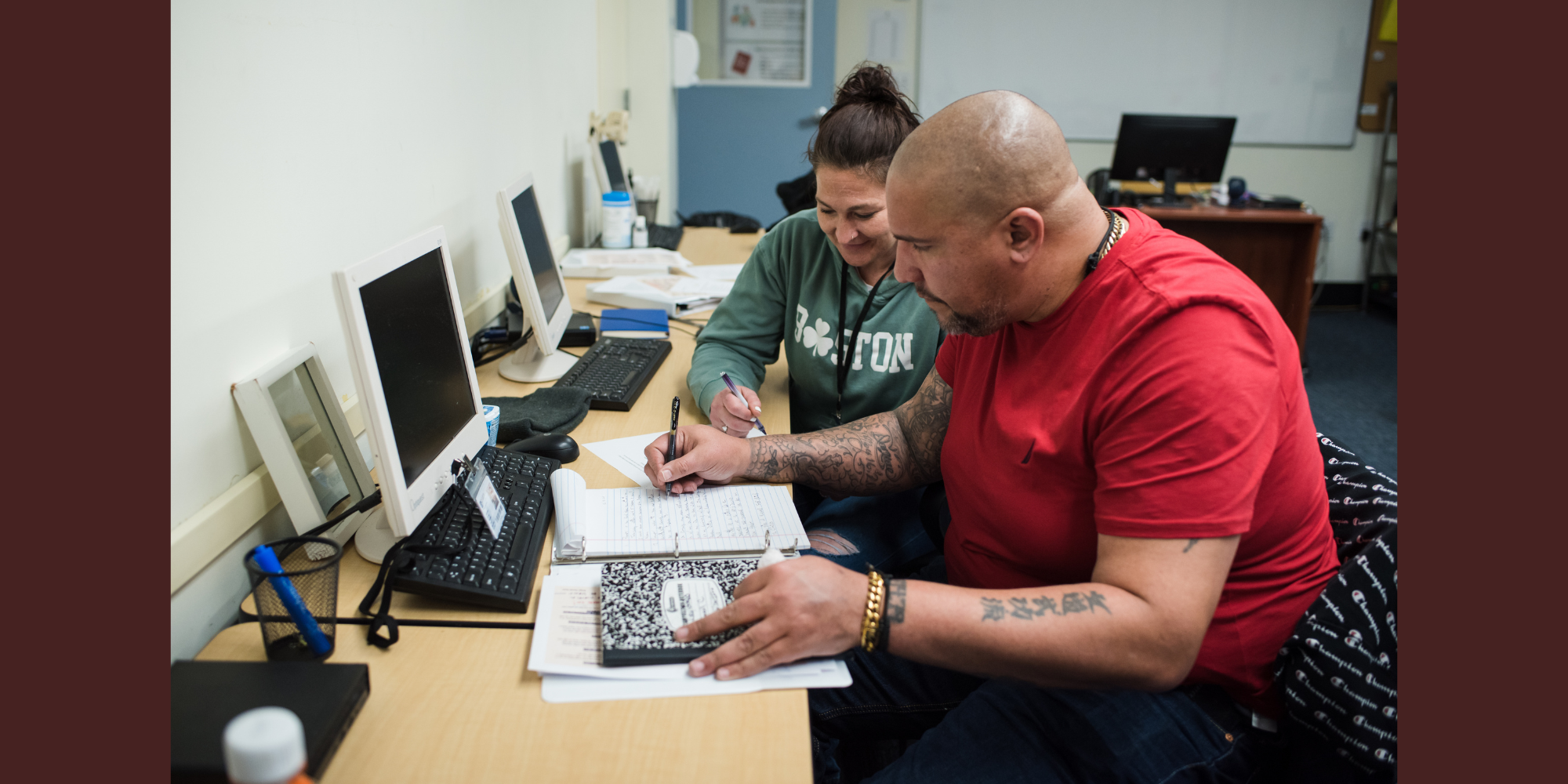
Boston’s St. Francis House offers hope, housing and healing
Br. Louis Canino, OFM, recalls his early days at St. Anthony Shrine in Boston during the 1970s, when he and fellow friars handed out sandwiches daily to just three to five people.
Forty two years later, that simple breadline has evolved into St. Francis House, a nonprofit providing transitional and permanent housing, healthcare, counseling, meals and other assistance to 10,000 people annually.
Br. Louis first served at the Shrine after his 1969 ordination and returned as rector in the early 1980s, when the daily bread line grew to 150–200 people. Societal changes, such as the closure of institutions for people with mental illness, had dramatically increased the number of people without housing who came to the Shrine for help.
“My initial reaction was ‘What are they doing here? Why don’t they help themselves?’” he said. “It took about three months of going out and mingling with the people to feel as if it was planted in my heart to do more.”
The friars and the Shrine's Justice and Peace Committee considered ways to support the growing volume of visitors needing more than food.
Br. Louis, with the late Brothers John Quinn, OFM, Joe Nangle, OFM, and the lay committee, decided to create a daytime shelter for the homeless. He explained that other organizations provided overnight shelter, but they closed each morning, meaning whatever the Boston weather dished out, people had nowhere to go.
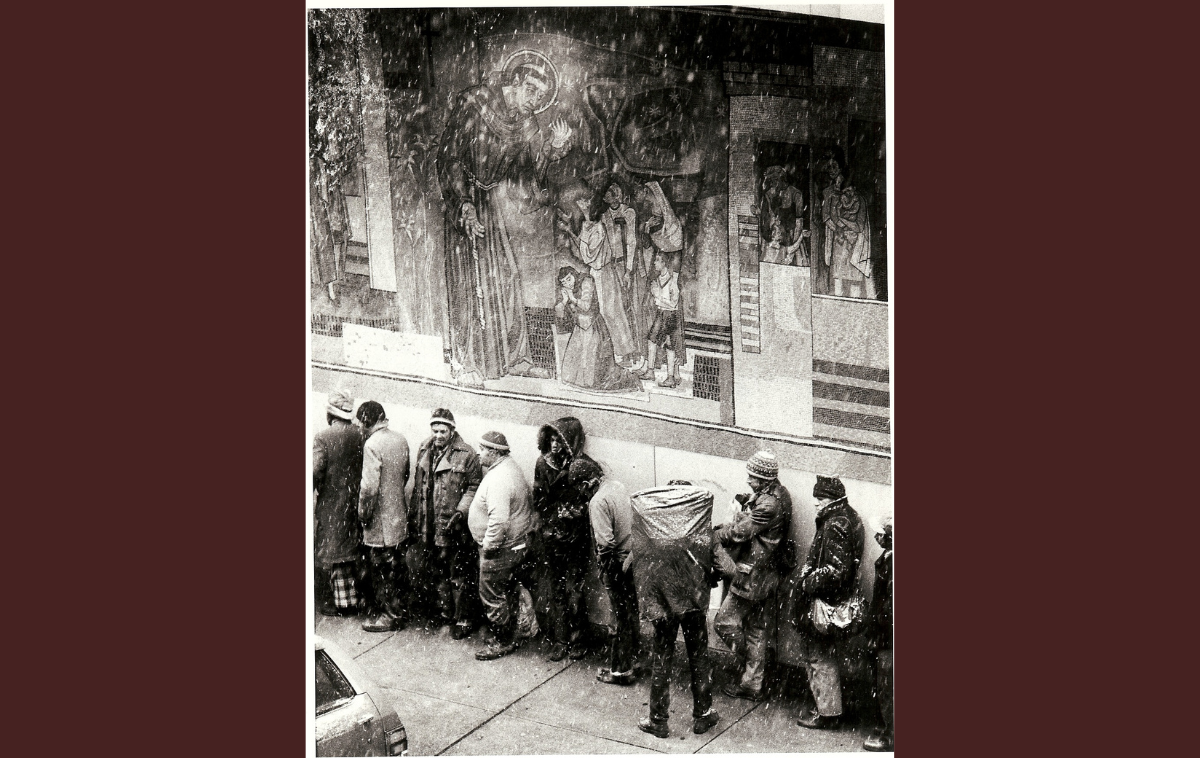
An undated file photo shows people lined up in the snow at St. Francis House in Boston, which supports homeless single adults when few services are available. (St. Francis House photo)
An inclusive, nonjudgmental space
When a nearby property became available, Br. Louis secured funding from the Portuguese Franciscan province, the Shrine community and a local bank. St. Francis House opened on Boylston Street in downtown Boston shortly afterward.
Karen LaFrazia, CEO and executive director of St. Francis House for 28 years, has seen the ministry evolve from a day shelter to an independent nonprofit serving 10,000 people in 2024.
From its founding, St. Francis House differed from other social services programs. “In the late 1970s and early 1980s, there was not much hope for the homeless population of single, unaccompanied adults,” Karen said. “We understood the necessity of meeting basic needs but with more kinds of help.” St. Francis House offered a nonjudgmental, welcoming environment, where clients could find “layers of integrated services.”
In Boston’s business district, the center provides shelter, meals, job placement, support for people recovering from substance abuse, medical care and housing assistance to those experiencing homelessness or with low incomes. The Boylston building houses 56 people in single rooms through the Next Step program, offering furnishings, shared living spaces and access to meals, counseling, laundry, fitness rooms, computers, libraries and on-site meetings. Some residents have stayed for over 15 years.
Across
the street, St. Francis House now includes the former Young Men’s
Christian Union building. In partnership with the Planning Office for
Urban Affairs of the Archdiocese of Boston, the building known as The
Union at 48 Boylston includes 46 units of affordable housing for both
people who have been homeless and others of modest income.
St. Francis House has hosted some residents for more than 15 years. Permanent housing gives residents the opportunity to get their lives back on track. (St. Francis House photo)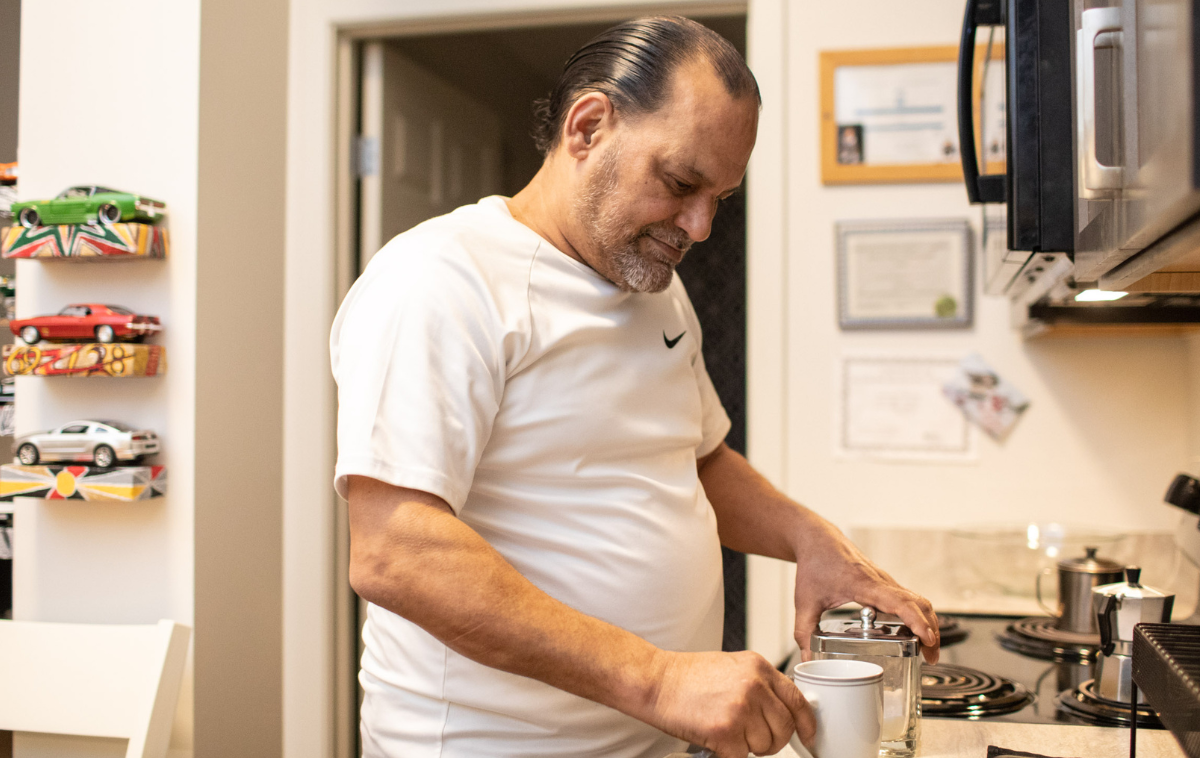
‘They will help you any way they can’
Jerome Douglas moved to Boston from Georgia during the COVID-19 pandemic after his brother Oscar passed. After 35 years of challenges, Jerome hit rock bottom.
“I came to St. Francis House as an addict, looking for housing and to get my license back,” he said. “After I got sober, my work became to stay sober and encourage others to do the same.” He is now a plumber who leads Friday recovery meetings at St. Francis House and appreciates its support for himself and others. “They will help you any way they can, as long as you put forth the work,” he said.
Jerome’s journey was highlighted at St. Francis House’s 40th annual gala in 2025, which raised $820,000 for its programs. In partnership with the Boston Archdiocese Urban Affairs Office, a new building opening this year will offer 126 apartments, including 70 for permanent housing.
The event recognized St. Anthony Shrine friars, including Br. Tom Conway, OFM, executive director and board treasurer of St. Francis House.
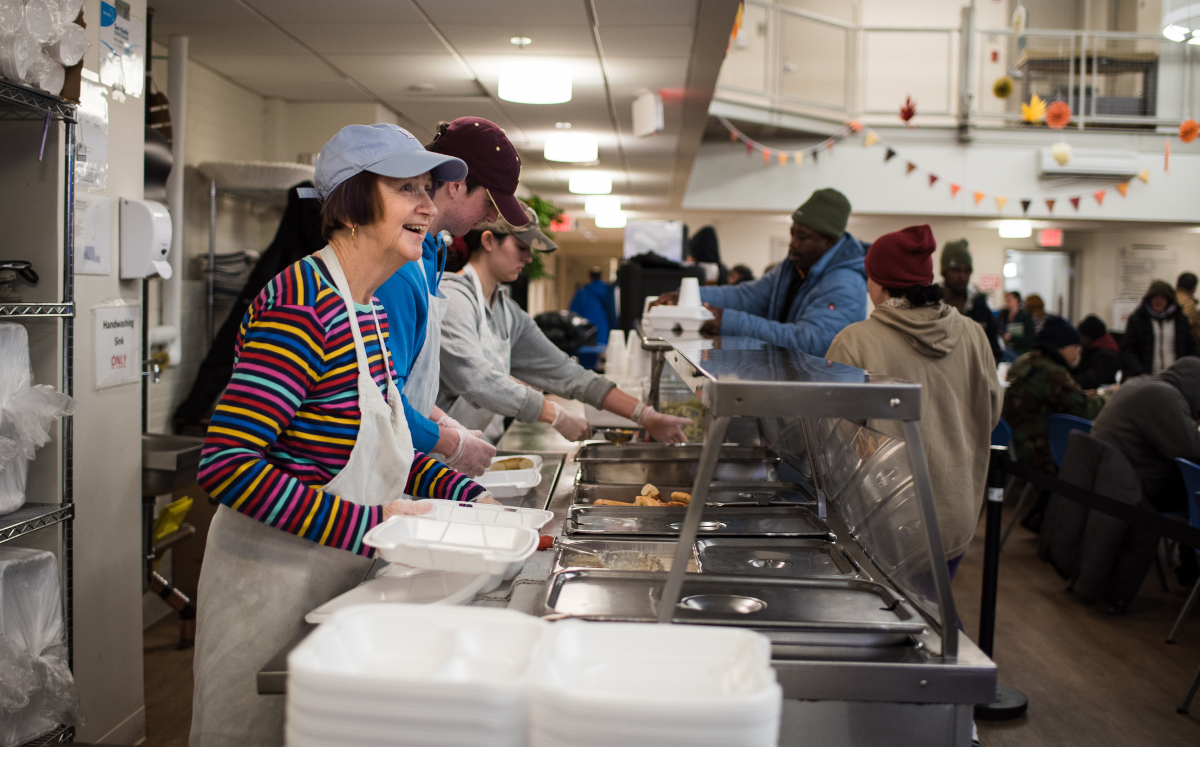
Food service volunteers ensure the St. Francis House can meet the needs of the community it serves. It’s one component of a ministry that differs from many others out there. “We’re better equipped to help folks who need individualized attention,” said Br. Tom Conway, OFM. (St. Francis House photo)
Specializing in detailed care
Br. Tom said that the Shrine and St. Francis House have grown together. In addition to 21 weekly Masses and spiritual services, the Shrine also offers social services, although smaller in scale. Its ministries include a women’s medical clinic (with Boston Care for the Homeless Program), counseling, recovery assistance, a food center, veterans aid, and funeral services for the homeless through the Lazarus Ministry.
“We’re better equipped to help folks who need individualized attention,” who may be reluctant to go to the more bustling St. Francis House, he said. The women’s medical clinic specializes in detailed care, serving about 10 people a day. Unlike medical clinics that aim to treat as many people as possible and move them out, they keep them there as long as they need. “It’s all about building trust, slowing the process,” he said.
Mary Ann Ponti, outreach director at St. Anthony Shrine, said many homeless women choose St. Anthony for its trauma-informed care and peaceful environment.
The two ministry centers “really are cornerstones in downtown Boston,” said Ponti. “There’s a tremendous amount of Franciscan love that shines in both places.”