

Seeking Gospel hope in a world increasingly shaped by AI
How can we stay rooted in the dignity of the human person amid rapidly advancing technology? Br. Steven Patti, OFM, recently considered that question with parishioners at St. Camillus Church in Silver Spring, Maryland, during a series of discussions on Pope Leo XIV’s encyclical Magnifica Humanitas. In this reflection, Br. Steven shares what they discerned about AI, human dignity and the hope found in the Gospel.
Br. Jorge Hernandez, OFM, pastor of St. Camillus Church, asked me if I would give a reflection on Pope Leo’s recent encyclical, Magnifica Humanitas. And so, for three successive Saturdays in September, for two hours each session, a group of us met in the Francis Room to discuss the encyclical, with chairs set up in a circle around the room.
Most had heard about the encyclical, but few, if any, had read it. They were curious and interested in learning more. We looked at several questions: What is an encyclical? What is Leo doing in this encyclical? What did we find in it over our three sessions?
Magnifica Humanitas is lengthy, and much of it is rooted in the Bible and in Catholic Social Teaching. Leo XIV refers to his predecessor in name, Leo XIII, and to Leo’s Rerum Novarum, which addressed the rising industrialization of the late 19th century. We talked about how it was no accident that our modern Leo chose his papal name: Both popes show a deep concern for the centrality of the human person amid rising industrialization and technology, 135 years apart.

Br. Steven Patti, OFM, said participants in a discussion about Magnifica Humanitas expressed concern about the fate of humans, given the rapid rise of artificial intelligence. (Photo courtesy of Br. Steven)
The human person in an age of AI
This resonated with people. The group expressed fears: What is happening to our world around us? Where is, and what is the fate of, “the person,” the human person, amid an emerging world of AI? What and whom can I trust amid rising disinformation, surveillance and data collection, and AI as a social companion? What does it mean when AI gives answers without any authentic sense or knowledge of mercy and compassion? What does AI mean for the future of warfare?
‘Humanity at risk’ was a common topic of conversation among the group, along with a sense that the human person is increasingly becoming a cog in a machine. There was also a sense of gratitude for the pope’s words, for his speaking publicly and prophetically about an issue that seems to develop in new ways daily.
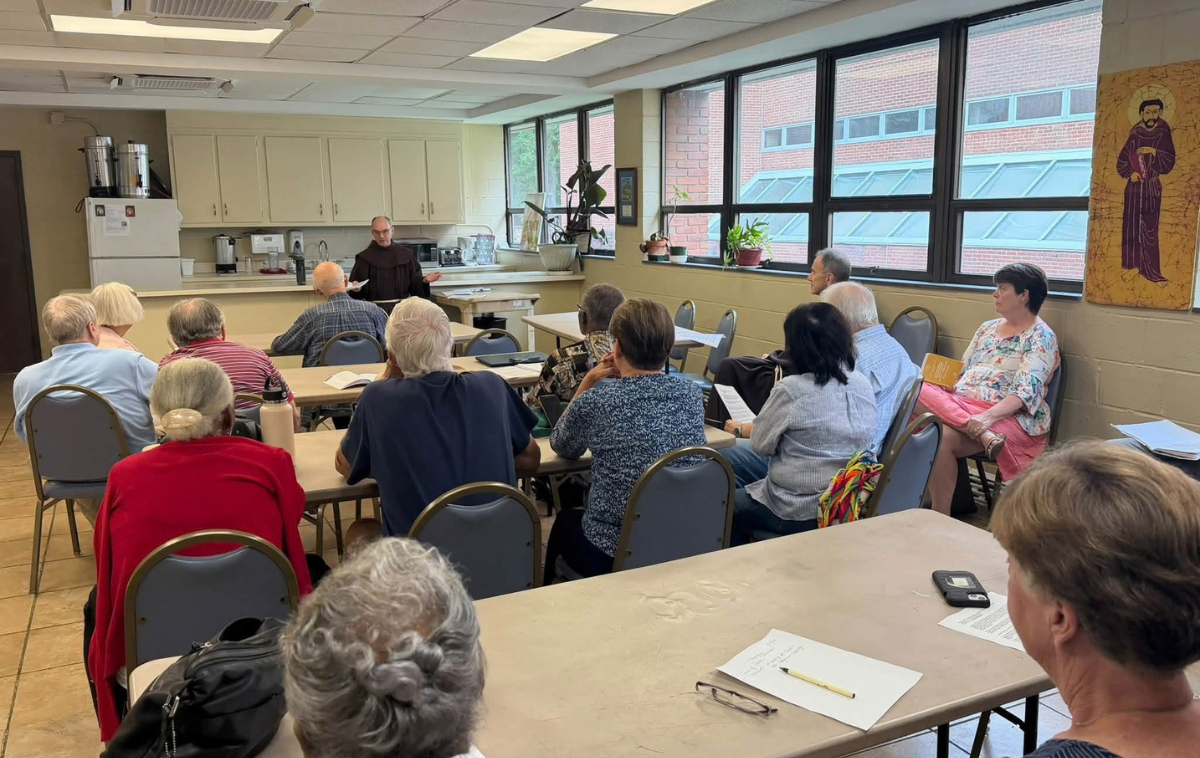
In the discussions Br. Steven Patti, OFM, led, he mentioned that Pope Leo XIV reminds us who we are called to be during a social shift that can at times feel baffling and confusing. (Photo courtesy of Br. Steven)
Rooted in the Gospel
But the news was not all grim. Even amid an ever-changing technological landscape, Magnifica Humanitas points to the Gospel, to who we are as disciples of Christ in our modern world. Leo reminds us who we are called to be amid this often bewildering and disorienting social change.
He writes beautifully and with hope: “Even in the darkest nights, the Lord raises up men and women who refuse to give up, who persevere in doing good, who protect the vulnerable and open pathways to reconciliation” (MH 211). He adds, “Do not think that the problems are too big, and that we are too small” (MH 212).
And so, what did we find after three Saturday morning sessions?
It felt like modern Church: a naming of the signs of the times, shared voices around the circle, and a shared sense that the Gospel and our entire Christian tradition root us in the centrality and dignity of the human person and in how we are called to follow in the footsteps of Jesus.
As Pope Leo ends his encyclical: “With the same faith as Mary, let us become weavers of hope in our world, sharing who we are and what we have, so that the presence of Jesus may grow among us and his kingdom take shape” (MH 245).