


.jpg?sfvrsn=91ac0e1d_1 "Franciscan Wisdom in a Time of Crisis_web thumbnail_800x960_12_Marie Dennis(1)")
.jpg?sfvrsn=a7de5eb8_1 "Franciscan Wisdom in a Time of Crisis_web thumbnail_800x960_09_Jacek Orzechowski(1)")

A Franciscan View: Dialogue Over Destruction
Author: Office of Justice, Peace and Integrity of Creation
Date Published: March 31, 2026
Keeping up with the news is hard. Making sense of it is even harder. That’s why the Province of Our Lady of Guadalupe’s Office of Justice, Peace, and Integrity of Creation is launching “A Franciscan View,” a series to help you reflect on the news through a Franciscan lens.
Whether it’s today’s headlines, trending topics or current events, you will discover a new perspective rooted in the Franciscan tradition. You will hear from friars and other Franciscan-hearted individuals who carry out the mission of Jesus Christ through the example of St. Francis of Assisi.
Their words may challenge you to think differently, take action or pray more deeply. Our hope is that you will not only watch the news — you will be transformed by it to become a witness of God’s peace and justice in our world today.
A Franciscan View: Dialogue over Destruction
The Iran war is historic on many fronts. The strategic goals of the U.S. and Israel are intentionally ambiguous, and energy infrastructure is a central battlefield, not a secondary one. So far, over 4,500 lives have been lost. Explosions and destruction light up our screens daily.
Why it matters
While the war may seem like a video game to some — especially with the way the U.S. Administration is promoting it through memes and other social media — suffering is real for the innocent victims of this war. Three million people have been displaced, people are mourning family members, and many are struggling to keep up with rising costs.
The Franciscan witness
The violence that is sweeping the Middle East is not unlike the violence faced by St. Francis of Assisi and his early followers, who suffered from the violence of banditry, and witnessed conflicts between cities and nobles as well as the Crusades.
St. Francis of Assisi and his early followers responded by trying to build a counterculture of peace. Their actions were not starry-eyed, empty announcements of “peace and good” (pace e bene). They took strategic actions of preaching, conflict resolution, deep dialogue with enemies and prohibition on the carrying of arms by lay followers.
These actions unlocked a moral imagination that envisioned a world that made peace normative. In fact, for nearly 100 years after Francis’s death, central Italy and other parts of western Europe with a strong Franciscan presence saw a marked reduction in conflict between cities.
Learn more: Franciscan TV’s Friar Time recently interviewed Middle East expert Fr. Elias D. Mallon, SA, who explored the human cost of the war with Iran and the spiritual changes necessary for real peace to become possible.
.png?sfvrsn=a286b929_1)
US aircraft sit on the flight deck of USS Abraham Lincoln on Feb. 27, 2026. (Image courtesy of the United States Department of Defense)
The Catholic response
On Palm Sunday, Pope Leo XIV made one of his most direct statements on the war and those attempting to justify it:
“Brothers and sisters, this is our God: Jesus, King of Peace, who rejects war, whom no one can use to justify war, He does not listen to the prayers of those who wage war, but rejects them saying: ‘even though you make many prayers, I will not listen: Your hands are full of blood.’”
This follows numerous statements over the last month from Pope Leo, Cardinal Pizzaballa, Cardinal McElroy, and Cardinal Cupich just to name a few.
Conversation starters
In the light of Pope Leo’s statements, how do we continue to see the humanity of others with whom we disagree in order to engage in deep dialogue?
What obstacles or opportunities do you see in doing nonviolent actions with local groups or with partners like Pace e Bene?
Do we regularly incorporate calls for action into our prayer and worship?
How else can we share our Franciscan tradition to construct a counterculture of peace for our world?
Closing prayer
God, give us the creative imagination to discern and moral strength to bring your peace to the world... Lord, hear our prayer.
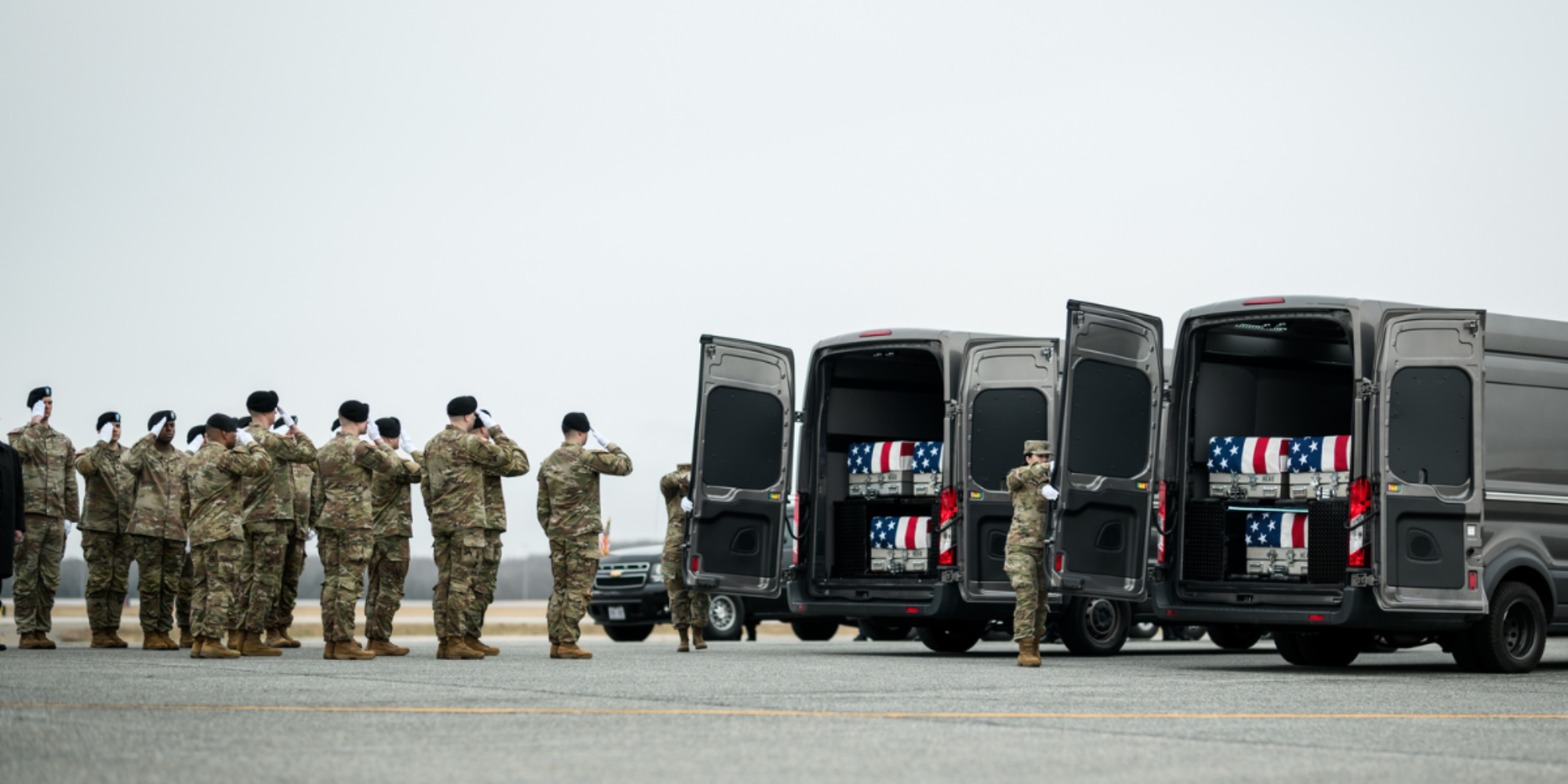
The main image used with this article is a photo of the dignified transfer of remains of six U.S. soldiers killed in an Iranian drone strike in Kuwait that took place on Saturday, March 7, 2026, at Dover Air Force Base, Delaware. (Official White House Photo by Daniel Torok)