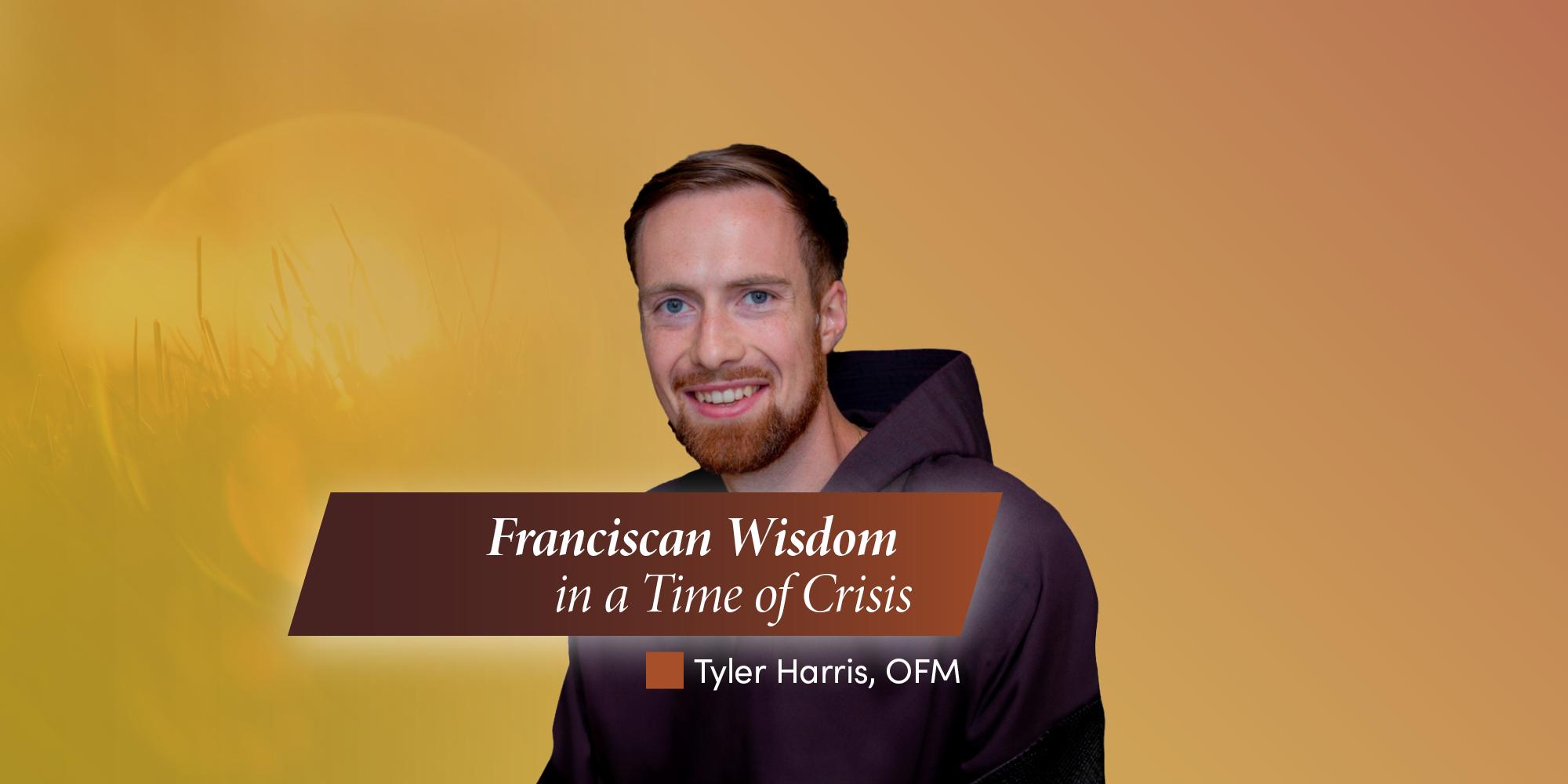
Franciscan Bravado for Young People
“He rejoices in all the works of the Lord's hands,
and through their delightful display
he gazes on their life-giving reason and cause.
In beautiful things he discerns Beauty Itself;
all good things cry out to him:
‘The One who made us is the Best.’
Following the footprints imprinted on creatures,
he follows his Beloved everywhere.”
What an extraordinary witness! To delight in beauty everywhere, to be constantly reminded of “life-giving reason” and drawn back to God with ever greater fervor. Such a vision awakens a deep longing for meaning and inextinguishable joy most of us recognize. This enchanting image of St. Francis by Thomas of Celano is breathtaking. But, it is the next line that, I suggest, should really give us pause: “He embraces all things with an intensity of unheard devotion, speaking to them about the Lord and exhorting them to praise Him.”(1) Not only did Francis gaze on Christ in all things, but then he spoke to all about Christ “with an intensity of unheard devotion.” During this Christmas season, I can’t help but think of the similarly dramatic account of the Greccio Nativity celebration, in which Francis passionately preached about the “babe from Bethlehem.” With such “sweet affection,” Christ was “awakened and impressed” in “the hearts of many” who had long forgotten about the Incarnate Lord. (2)
I begin with these two images of Francis because they reflect his bold, exuberant pursuit and proclamation of Christ—a passionate Christocentric bravado. The purpose of this reflection is to make the case for such a “Franciscan bravado:” a bold witness of our tradition uniquely suited to address the crises facing young people today.
Let’s begin by trying to see the world through the eyes of a young person born since the late 1990s whose entire life has been marked by one major disruption and fracturing of life after another. Many have never known a world without smartphones in their pockets and screens mediating relationships. Reading has been reshaped by scrolling; life’s most complicated questions are flattened into 30-second videos; and now AI makes studies and career-planning seemingly futile. Add to this the simplification of everything to clicks of on-demand buttons that increasingly atrophy our collective openness to hard work. Plus, there’s the political and cultural landscape defined more by outrage and division than shared meaning. Nothing seems to be certain in this world, and everything remains watered down, lukewarm, and fragmented. Consequently, there’s an aching hunger for boldness, for conviction, for something real. When all that is being offered seems to be more of the unsatisfying gray void of superficial platitudes or unconvincing ambiguities, it is understandable that their appetite turns to loud, angry voices that satisfy the deep craving for certainty and boldness.
Fortunately, we are privileged bearers of a tradition that is intentionally down-to-earth, direct, and embodied: focused on what is real and concrete, good and beautiful before us. Our incarnational vision and spirituality ought to pair very nicely with today’s generational hunger for what is real and authentic. Plus, we follow after the example of “God’s Troubadour” who, totally caught up in the wonder and humility of the Incarnation, could not contain his conviction and joy. His zealous awe before God was the message that captured hearts then and can still capture hearts today. Let us ask ourselves: What might that craved-for “bravado” sound like in a Franciscan key? How can we draw from our tradition to boldly serve this generational hunger for concrete sources of meaning, hope, and joy?
Let me begin with an extraordinarily bold declaration from Francis himself: Consider, O human being, the wondrous state in which the Lord God has placed you, for He created you and formed you to the image of his beloved Son” (Admonition V)
This line took my breath away the first time I read it, and it remains one of my all-time favorite lines of Francis’ writing. Recalling the intentionality, goodness, and beauty with which God created us—and the depth of union with Christ we have been designed for from the beginning—changes absolutely everything. However, such self-reflection is not for the faint of heart. Far from a gentle, conditionless affirmation, this proclamation of our goodness formed in the image of Christ makes an astonishing demand of us and invites us into a life far more than ourselves. I desperately wish more young people in my generation could be inspired by such an unparalleled affirmation and extraordinary claim on their life. However, confidently proclaiming such a message in a highly individualistic, relativistic culture takes unflinching, unapologetic boldness.
But the boldness of Admonition V is only a nascent foretaste of our tradition’s daring conviction in the Absolute Primacy of Christ—God’s unconditioned willing of the Incarnation from the beginning of time.(3) This vision of Christ and the Incarnation, unapologetically articulated by Bl. John Duns Scotus, has a jaw-dropping quality to it. I’ll never forget how exhilarating it felt to discover unknown doors opened in my heart and unconscious questions answered in my mind upon first hearing Scotus’ explanation of the Incarnation. This vision of Christ undoubtedly filled my life with newfound depth and meaning. To this day, I can think of few more luminous expressions of a “Franciscan bravado” than boldly confessing the Absolute Primacy of Christ.
Nevertheless, this bold teaching is often presented in a Plan A vs. Plan B logic (e.g., if Adam hadn’t sinned, God would still have become human). But, that explanation sounds like a mincing of foreign and unrelatable words to an increasingly uncatechized, secular generation. And, to those few catechized in a generation hungering for certainty, that Plan A vs. Plan B explanation smacks of a largely irrelevant thought experiment divorced from reality in a world so obviously in need of redemption.
So, I propose approaching the Absolute Primacy of Christ from a different angle: not as a speculative claim about what might have happened but as a bold confession about what is most real right now. If all of creation and all of history have always pointed to Christ, then Christ remains the absolute center of creation and all existence today. We all exist for Christ. We all find our deepest fulfillment in Christ. And absolutely nothing makes sense apart from Christ. This is not a thought experiment; it is a claim about reality itself.
This vision of reality has urgent consequences in a world marked by affective polarization, outrage, and fragmentation—sad realities that young people experience acutely. The tantalizing and thought-provoking image from St. Bonaventure comes to mind when he writes of God as the One “whose center is everywhere and whose circumference is nowhere.”(4) Perhaps, despite all appearances, we do share a deeper center even with those we most vehemently oppose—a center much closer than we can possibly imagine. Thus, the truth that Christ would always enter our messy humanity can give us a new light and new hope for maneuvering the dizzying mine-field of polarization. Our joy before Him cannot be held hostage by passing divisions or ideological certainties. The Primacy of Christ relativizes every false center that competes for our allegiance.
But this conviction must be embodied. For a younger generation suspicious of abstractions and starved for what is concrete, this vision only becomes compelling when it is visibly lived. If Christ truly is the absolute center, what difference does that make in our friaries and fraternal life? How often do we speak—plainly and publicly—about our daily encounters with Christ and his continued centrality in our lives? How clearly do we give witness to our discovery of fulfillment and purpose within community with Christ as our only source and summit? Such bravado just might convince young people that unapologetically following in Christ’s footprints and laboring for justice through the dark, uncertain valleys of life to the luminous mountaintops is not naïve, but worth absolutely everything.
My generation, constantly inundated with bad news of global suffering, often needs to be convinced that there’s a sufficient reason for hope and joy to combat widespread apathy and indifference. We need convincing that Christ can still feed us, that falling in love with Christ still makes sense, that giving birth to Christ through holy actions is actually possible. We need loud, bold witnesses to the Christ that really is the absolute center and source of all that is good.
We cannot be afraid to lead with audacity. Our Franciscan tradition—rooted in beauty, humility, and incarnational realism—offers young people something rare: a way of seeing life as definitively immersed in goodness and grace, ordered toward love, and absolutely centered on Christ. May we have the bravado to live it visibly and share it boldly.
1. The Remembrance of the Desire of a Soul, 165
2. The Life of Saint Francis, 86
3. See Duns Scotus, Ordinatio I, d. 41, unica, n. 40–42; Ordinatio III, d. 7, q. 3; Lectura III, d. 19, n. 20
4. Bonaventure, Itinerarium, 5.8
.jpg?sfvrsn=91ac0e1d_1)