Caring for creation like Francis
In a world that cries out for peace and justice, Pope Leo XIV has announced a Jubilee Year of St. Francis – an urgent invitation to put our faith into action following the example of St. Francis of Assisi. As the Jubilee Year continues, the Franciscan Friars of the Province of Our Lady of Guadalupe will be sharing a monthly reflection to look honestly at our lives and ask what it would mean to follow the Gospel more closely in the spirit of St. Francis. Read other reflections in the Live Like Francis series.
"I wish to compose a new hymn about the Lord's creatures, of which we make daily use, without which we cannot live, and with which the human race greatly offends its Creator." The Assisi Compilation 83 (1244-1260)
Praised be You, my Lord, with all Your creatures,
especially Sir Brother Sun,
Who is the day and through whom You give us light.
And he is beautiful and radiant with great splendor;
and bears a likeness of You, Most High One.
Praised be You, my Lord, through Sister Moon and the stars,
in heaven You formed them clear and precious and beautiful.
The Canticle of the Creatures (1225)
In the Canticle of the Creatures (a canticle and therefore a song rather than poetry) St. Francis composed the greatest and most well-known of all his writings a year before his death.
Suffering from a form of leprosy, burdened with the Stigmata, and marginalized by the community he tried to lead, Francis did not succumb to despair or hopelessness. Rather, these afflictions awakened in him the realization that in everything that God has created lies the presence, the reality, of God.
The Canticle of the Creatures does not portray creation as static. Francis sees creation as alive with the presence of God, animated by the Creator and continually unfolding according to God's design. This insight is reflected in the Latin word creatura, which speaks not of something fixed but of something active, growing, fruitful. Near the end of his life, Francis recognized a simple but profound principle of sacramentality: all creation has the potential to reveal something to us of the wonder of God. Every creature is both a song of praise and a symbol of the God who creates and sustains all things.
The Canticle does not place humanity above the rest of creation. Rather, it admonishes humans to recognize and respect their place within all that God has created. It offers a strong critique of humanity's failure to live up to the divine command given to it in Genesis 1 – to act as stewards of all creation; to make a world out of what we have been given, a place where everything created knows its value and worth. That command remains as urgent today as it was in Francis' time.
Francis' appreciation for creation is more than environmental care. It is the revelation that humanity is connected deeply, radically and exceptionally to the cosmos, to that which is greater than itself. The Canticle hails this connection as the best and most profound way to encounter God. The water, bread, wine and oil used in the sacraments – created from this good earth – form the means of our continual encounter with God. Caring for creation like Francis, then, is both a call for all humanity to be attentive to this connection and to be good stewards of that which anchors our relationship with God.
Reflect:
What does it mean to act as a steward of creation? How might you act in a way that demonstrates to all created things their worth and value?
What experiences of creation and its creatures have left you amazed with wonder and awe? What in these experiences have helped you understand them as revelations of the wonder of God?
How does your experience of God's presence in creation shape the way you experience the sacraments? What created gifts used in our liturgies most help you encounter God?
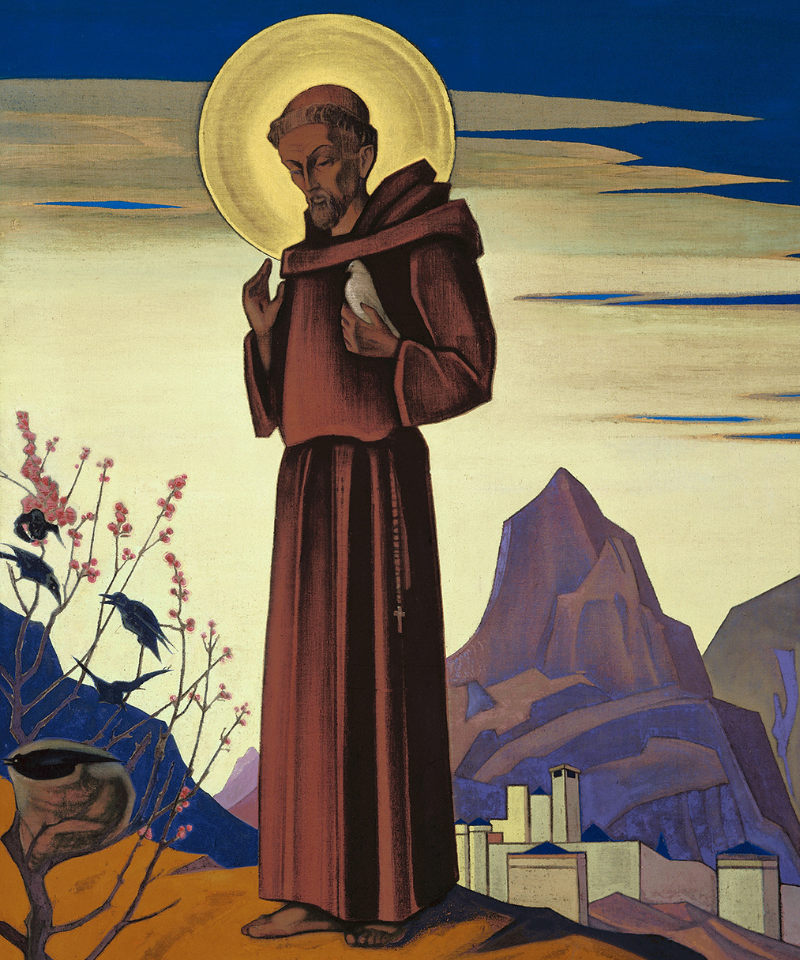
Image: Nicholas Roerich, Public domain, via Wikimedia Commons