
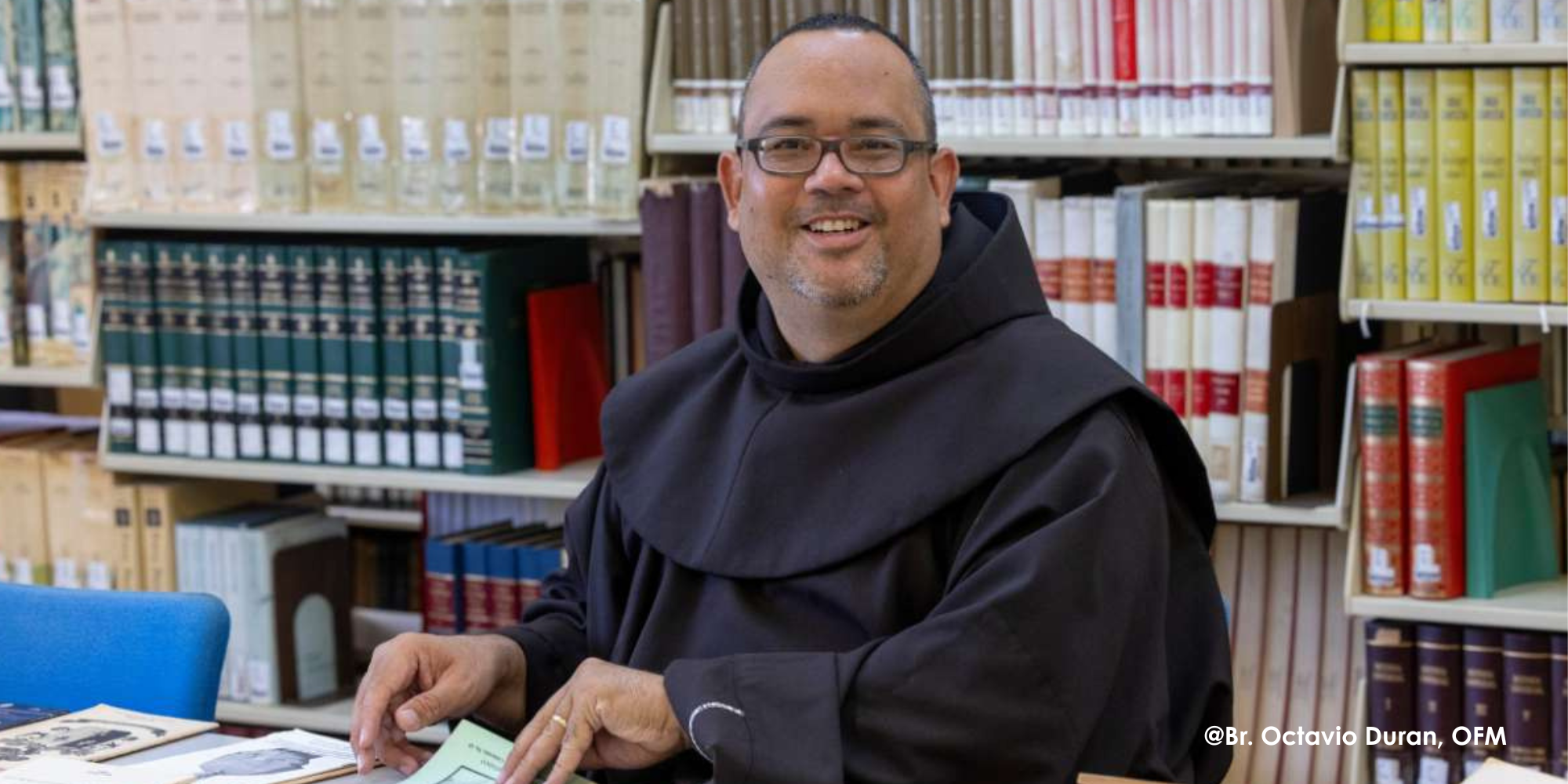
A conversation with Bishop-elect Gerardo Vargas Cruz, OFM
On Nov. 14, Br. Gerardo Antonio Vargas Cruz, OFM, will be consecrated to serve as coadjutor bishop of the Diocese of Fajardo-Humacao in Puerto Rico, where he will assist the current bishop and eventually succeed him.
A member of the Order of Friars Minor for nearly three decades, Bishop-elect Gerardo is a native of Puerto Rico whose ministry has been marked by service, humility and a deep commitment to accompanying people in their faith journey.
Known for his Franciscan spirit and concern for those on the margins, Bishop-elect Gerardo grew up in a working-class community and often speaks of remaining grounded in his roots. He is recognized for fostering hope, compassion and an approachable presence that reflects the Franciscan values of service and humility.
Bishop-elect Gerardo is part of the recently established Province of Our Lady of Guadalupe. In the following interview, he shares insights into how he will approach his new role, the challenges of evangelization today and how he discovered his Franciscan vocation.
When did you receive the call about becoming a bishop?
I received the call through WhatsApp while I was in Maryland for priestly ordinations. I didn’t recognize the number, so I didn’t answer. Then I saw the missed call and noticed the episcopal coat of arms. It was Archbishop Piergiorgio Bertoldi, the apostolic nuncio to the Dominican Republic and apostolic delegate to Puerto Rico. I called him back and he told me that I needed to come to the Dominican Republic as soon as possible. I stayed calm, but I was thinking, “How am I going to handle this?”
I went to the Dominican Republic, and he told me that Pope Leo had appointed me as bishop coadjutor of the Diocese of Fajardo-Humacao, which includes the eastern part of Puerto Rico and the island municipalities of Vieques and Culebra.
How did you react to the news?
I received the invitation with great joy and love. However, I never dreamed of becoming a bishop. When the nuncio called me, I was starting a university course, and I had lots of plans. I enjoyed teaching classes and living in fraternity with the friars. But the Lord changed my direction. Obviously, governing a diocese is not the same as working in a fraternity or a parish. I know there will always be some challenges on one side and great joy on the other. I have allowed myself to be led by God.
How will you live out the Franciscan charism as a bishop?
My life has always been about being a brother; even as a priest, always a brother. Not just to my brother friars, but to all people. That is who I am. My Franciscan spirituality as a bishop means that I will be myself. When it’s time to laugh, I will laugh. When it’s time to be serious, I will be serious. But I am not going to stop being who I am. If we try to be someone other than who we are, we become saddened. Our spark fades away.
How did you discover your vocation to be a Franciscan?
When I was about four years old, I said I wanted to be a priest. It’s one of those moments that seems engraved in my memory. I was always connected to the life of the Church, but I had a normal childhood. I participated in youth groups, even fell in love. You know how children go through stages saying they want to be a firefighter, a police officer, a teacher? I always came back to wanting to be a priest. At one time, I considered the diocesan priesthood.
Then, when I was beginning university, I met the friars at a gathering at the convent of the Dominican Sisters of Fátima, which is a Puerto Rican foundation. I saw the friars in their habits. I saw them joyful. I saw them singing and laughing. I saw how they related to one another. After this experience with the friars, I said to myself, “This is what I’m looking for. This is what I want to be.”
At 25, I entered the Franciscans. At that time, it was the Franciscan Custody of the Caribbean in the Dominican Republic. I did my postulancy there, then my novitiate. I returned to Puerto Rico, where I finished a bachelor’s degree in social work. Then, I studied philosophy and theology. When the vocational process began, everything happened very naturally. There wasn’t any pressure from my parents or anybody else. I naturally followed that path. And now, this new mission has also come naturally as another path. Interestingly, my hometown of Lajas has produced three bishops.
How do you see vocations and formation in the new Province of Our Lady of Guadalupe?
I worked in formation. Formation is very difficult work, just like vocation ministry, because we look for quick answers, right? A vocation takes time. We have to accompany the young people of today. Young people live in a secularized world. Therefore, I think young people need a formator who is a witness of Jesus Christ who knows how to accompany them, not to judge them, but someone who can also, as St. Peter says, give them a reason for our hope.
My last class at the university was interesting. Most of my students knew that I was leaving. Some were Catholics and some Protestants. On the last day, we were talking about the Bible and philosophical questions. I gave them simple answers from my lived experiences. I said, “Many of you have an erroneous understanding of the Catholic Church. But when you begin to live the Catholic faith, you realize how beautiful it is.” This is our vocation and our calling: to evangelize with our lives. Being a presbyter does not make you superior to everyone else. The presbyterate is a service. Thanks be to God, the Order forms us in the name of Jesus Christ for service, not superiority.
Throughout my Franciscan formation, I was formed first as a brother. I am simply a brother who serves as a priest. I am your brother. So, I would work with vocations through direct accompaniment, offering welcome and hope, but also connecting with social realities.
How do you think we should be evangelizing today?
Now, we must use modern means of communication for evangelization: the internet... , YouTube, all these things. However, the way we evangelize cannot be by imposition. It has to be by attraction. Evangelization has to be authentic, connected to the Word of God and from person to person. There has to be dialogue, but it needs a solid foundation. People today ask questions: “Why do you believe this? Why don’t you believe that?” This kind of evangelization isn’t, “I’m the priest; I’m in charge here, so what I say goes.” No. We are the holy people of God, walking together and bringing the Good News wherever we are.
How will you approach your role as bishop?
I will continue being a friar who at the same time is a bishop. I know there are specific titles corresponding to a bishop, but I would prefer to be called Friar Gerardo. I will continue signing my documents “Friar Gerardo” because that’s my identity. I will go about my work not focused on being a bishop, but on my mission to do the best I possibly can. When things start going to my head, I will just take off my shoes and walk barefoot as a reminder to never forget where I came from.
What do you think about the Franciscan expansion in Puerto Rico in the western part of the island?
It is something new. It brings joy. The friars are very happy about that presence. Things are going well. Right now, the Franciscan province has four houses in Puerto Rico. One in the west. Two in the metropolitan area (of San Juan) and one is in the east. The west is more rural. It has cities, but there are still rural areas where there is a strong faith. It is the region with Puerto Rico’s oldest Marian devotion to Our Lady of Montserrat. The oldest shrine is there in Hormigueros. It is an area of great faith, a Marian faith.
Do you have a message to the Province of Our Lady of Guadalupe?
Let us continue being Friars Minor. Let us continue being friars in communion with the Church. Communion with the Church does not mean that we all have to agree on everything. But in the end, wherever we are serving as friars, we have to make the Gospel visible. The Holy Spirit will show us how to do that. We can become afraid because the number of friars is decreasing. But we should not be afraid. Everything belongs to God. Let us do what we have to do, and God will take care of the rest.
(Photo credit: Br. Octavio Duran, OFM)